 Book a call
Our AI agent builds and maintains a live physics-based model of your airport, predicts disruption before it develops, and recommends recovery actions across your whole operation. Your planners decide which recommendations to implement.
Book a demo
A physics-based model represents your airport as a physical system: the geometry of stands and taxiways, the resources that serve each turnaround, and the aircraft and passengers moving between them.
From that representation, the model computes how a decision plays out: how long the stand stays occupied, when the tow clears, whether passengers reach the gate in time, what the next arrival finds waiting.
Our AI agent tests allocations inside the model. When a disruption has no precedent, it compares options on outcome and returns the one your airport can actually run.
A widebody arrives an hour behind schedule. Its stand is still occupied, so the next turnaround moves to a remote stand, and the tow, the GSE and the handling crew follow it there.
Minimum connection times no longer hold. Transfer passengers miss their onward flights, the reclaim belt allocation no longer matches the arrival, and the crew rostered for the next rotation is now at the wrong end of the terminal.
Your duty manager rebuilds the plan by hand while the delay is still propagating, working from a view that shows what has already gone wrong.
Our AI agent builds and maintains a live model that holds stands, taxiways, flights, terminal resources and ground handling together. Your team sees the airport as one connected operation rather than as separate systems that each report their own view.
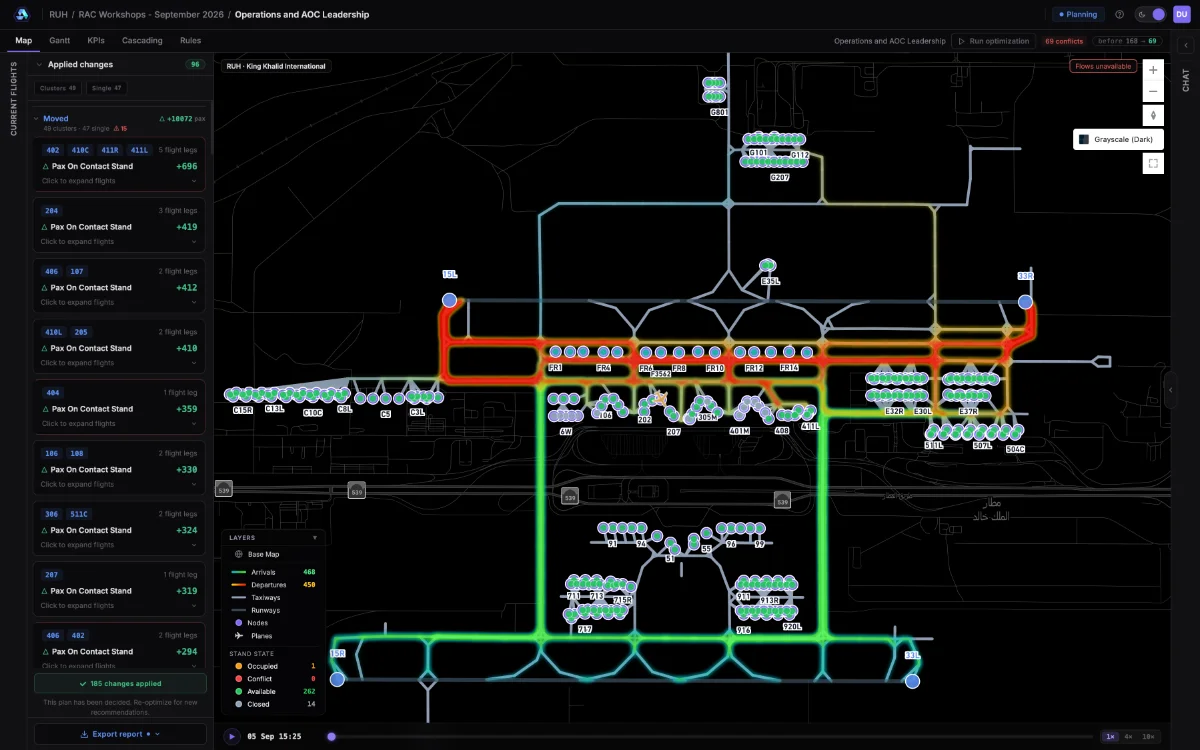
The platform reads live conditions and historical patterns rather than trusting the published schedule, so developing delays surface while your team still has options.
When a disruption lands, the model computes what it breaks downstream: which turnarounds conflict, which stands become unavailable, which connections fail, which belts and desks need reallocating.
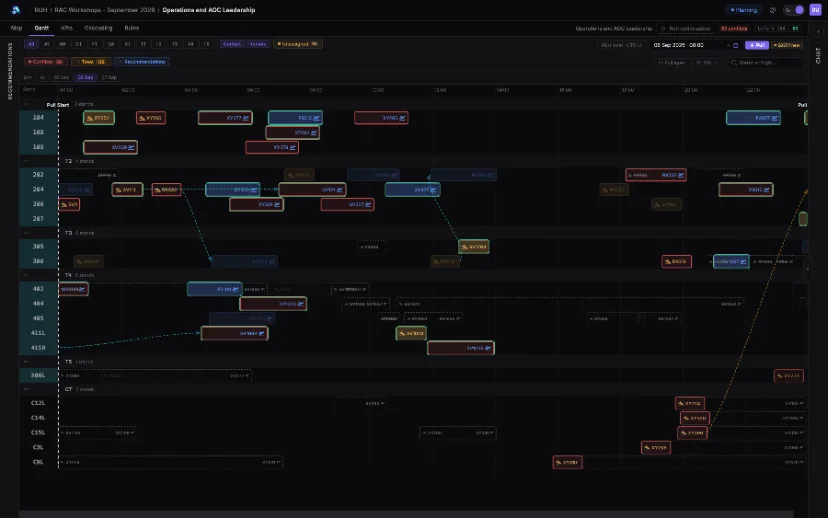
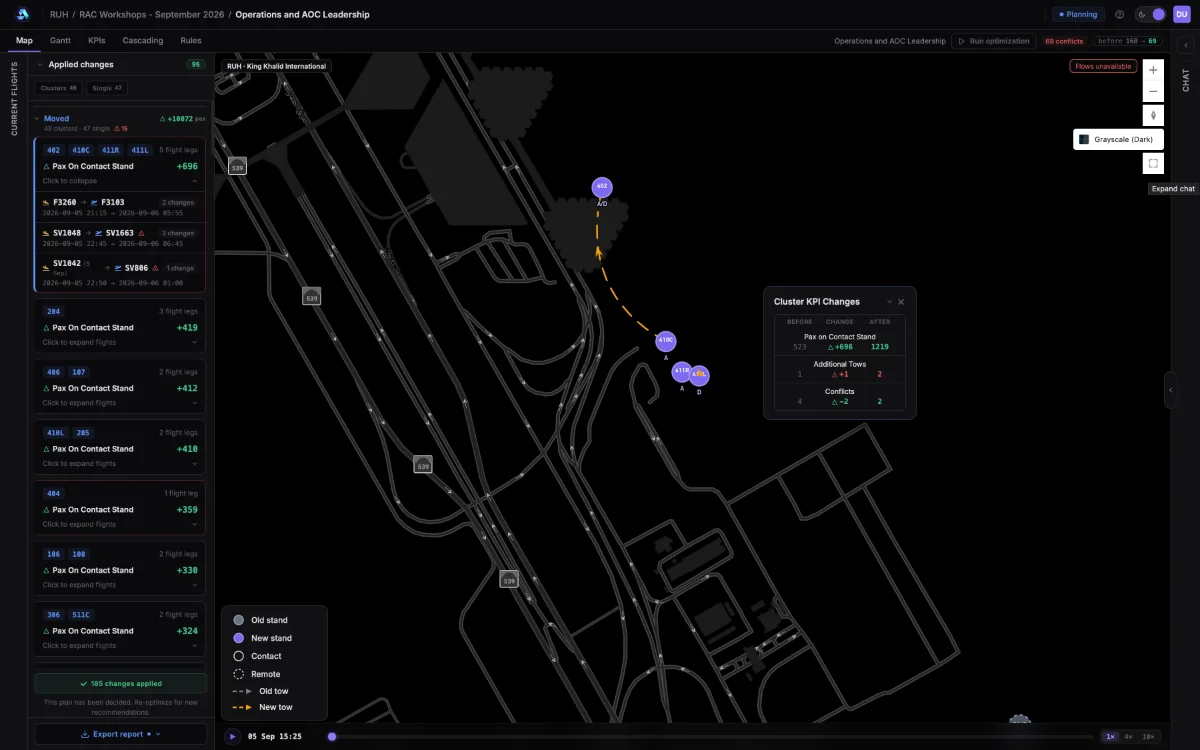
Our AI agent recommends the reallocations that undo the damage: moving a turnaround to a stand that clears in time, reassigning the belt to match the new arrival, resequencing tows so the next rotation departs on schedule. Each recommendation is tested against your hard and soft allocation rules and scored on passenger impact and aircraft movements. Your planners accept or reject what they see, and every decision teaches the model how your airport really operates.
Stand and gate allocation, remote stand reduction, towing plans, and conflict resolution as the schedule moves.
Baggage handling, GSE allocation, turnaround sequencing, and fewer unnecessary aircraft movements.
Reclaim belt allocation, check in desk allocation, crew assignment, transfer distance optimisation, and footfall balancing across the terminal.
Every horizon runs on the same model, so what your planners validate in season planning behaves the same way on the day.
Test a season's schedule against your stand and resource capacity, and trial allocation rule changes before they reach live operations.
The platform runs against live feeds in the AOCC and returns recovery options within minutes of a disruption.
Review operational performance by replaying it in our model, and work with our AI to identify areas for improvement.
improvement in asset utilisation at a Middle East hub handling more than 50 million passengers a year.
fewer passengers on remote stands at a major Middle East airport handling more than 35 million passengers a year.
increase in planning efficiency at a major East Asian airport handling more than 30 million passengers a year.
The platform connects to your AODB and flight operations systems, to A-CDM and ADS-B feeds, and to open sources for weather and network conditions.
Aleph Aero™ runs inside your own environment, and Aleph does not host your operational data. The platform supports single sign on and role based access, and keeps a record of every recommendation, planner decision and plan version.
Bring last week's worst disruption to the first call.